Jean Monnet, founding father of the European Union
Demand from overseas has long supported Europe’s leading companies. But Europe is now being pushed to invest in itself and rethink its own rules, adding a further source of demand closer to home.
Defence is one area where we see this. At a summit in The Hague in June 2025, NATO allies agreed to raise spending on defence and security to 5% of national income by 2035. The EU has backed this with up to €150 billion of loans to help countries buy equipment and a €1.5 billion programme to expand European defence manufacturing.
Theon International is one example of a business well placed to benefit from this. The Greek-founded company, recently added to our Smaller Companies Fund, makes night-vision and thermal imaging equipment. In December 2025, it signed a contract worth around €1 billion for 100,000 night-vision goggles for the German army. Contracts of this kind often run for years, giving Theon a visibility of demand that few smaller companies enjoy.
Beyond military products and services, spending on defence-related infrastructure can also improve trade links. In Finland, for example, upgrades to key Arctic roads are vital for military preparedness, but they also carry heavy goods to and from Norwegian ports. Broader still, we believe the need for greater investment in defence could be a catalyst for a wider change in how Europe approaches public spending. For years, governments concentrated on balancing their books and left the central bank to support growth. Rearmament is more challenging to square with that approach. Germany, long the most cautious of borrowers, has rewritten its fiscal rules to free up defence spending and create a €500 billion infrastructure fund. Brussels has also relaxed EU budget limits so that other countries can spend more on defence. In this respect, much of Europe is starting to look a little more like the United States, where government spending has long been used to drive growth and security. Whilst performance is of course never guaranteed, for the businesses we invest in on behalf of clients, multi-year government budgets provide the predictability of demand that can set an entire supply chain, and the broader economy, in motion.
For a glimpse of what consistent government spending can do, look across the Atlantic. Over the past two decades, US budget deficits have more than tripled, from 2% to 7% of national income, while Europe’s fiscal stance has remained comparatively tight. That spending has injected demand, liquidity and risk appetite into the American economy, and alongside easy financial conditions it has supported companies’ pricing power. As a result, the US has seen profit margins expand and earnings grow. In combination with more abundant liquidity, valuations have been driven upward. Europe’s weaker growth, tighter budgets and slower margin expansion have, by contrast, placed a ceiling on any growth in valuations.
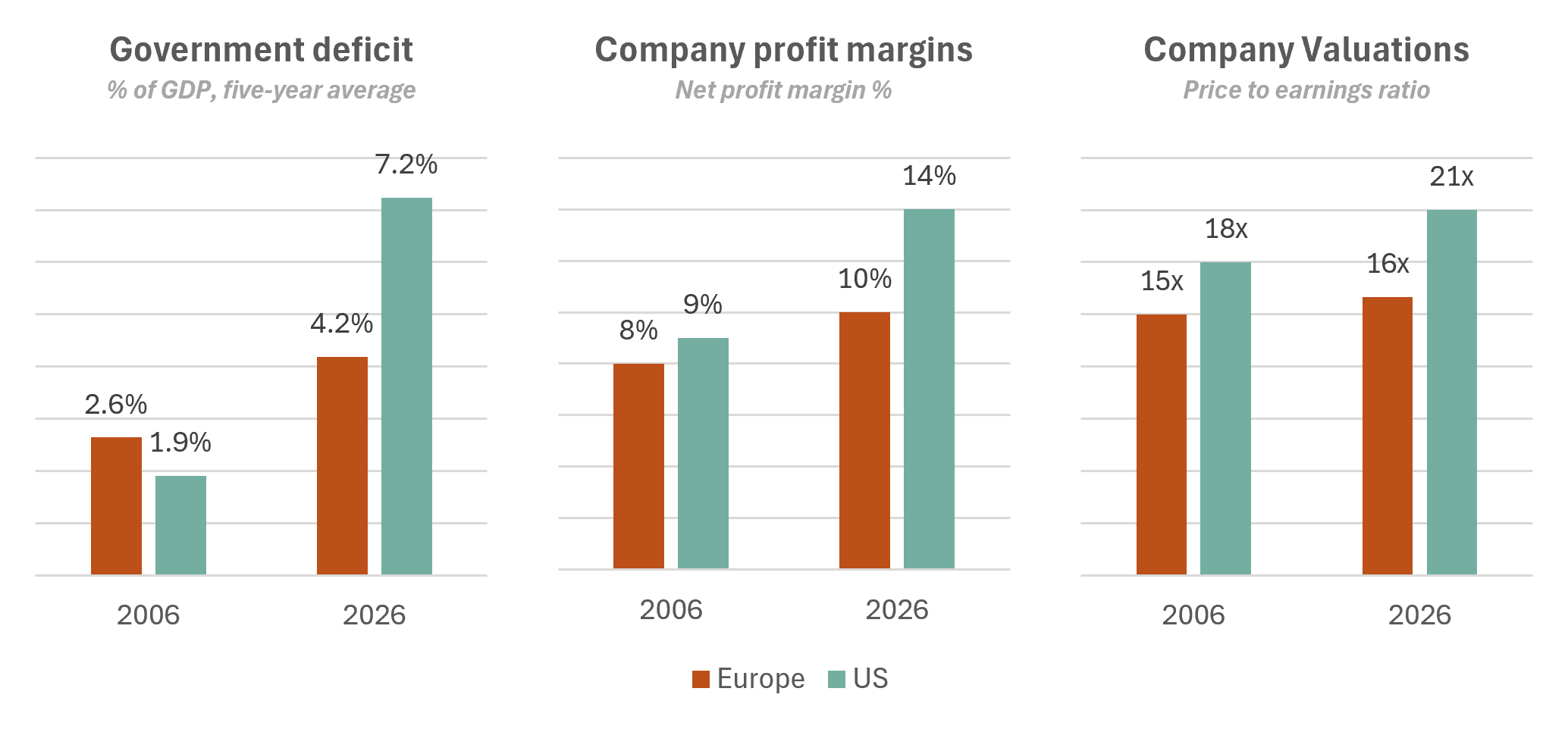
Sources: FRED, OECD, Bloomberg, MSCI. Note: Budget deficits refer to trailing 5-year average, profit margins are trailing 12-month net profit margin and valuations are 1 year forward P/E ratios of MSCI Europe ex-UK and MSCI USA Net Total Return. Market data correct as at 31/12/2005 and 27/10/2026.
If the European fiscal mindset moves even partly towards the US end of the spectrum, the benefits could be meaningful. The looser fiscal stance now being taken will support domestic investment in key growth areas, benefitting European companies that already enjoy exposure to a robust US economy.
Different currents
Where we see the US and Europe diverging is energy policy. Scepticism towards renewable energy has grown in the US, manifesting in formally leaving the Paris climate agreement earlier this year. Parts of Europe have not been immune to that thinking although, encouragingly, the continent as a whole is largely pressing ahead with its goals and investment plans.
European investment in renewable generation now exceeds investment in fossil fuel power by a wide margin. For every €1 invested in new fossil fuel power in the EU, around €35 now goes into renewable generation, up from €6 ten years ago. In 2023 the European Commission estimated that €584 billion of grid investment is needed, and in December 2025 it proposed new measures to speed up planning and permitting.
August 2026 was the joint warmest month globally on record, a reminder of the long-term case for clean energy. There is a more immediate reason too. A true prisoner of geography, Europe has little oil or gas of its own, which leaves it exposed to events beyond its control, as the gas crisis of 2022 made painfully clear. Generating more of its own power gives Europe greater control over its supply and, over time, less exposure to global fossil fuel prices. There is, of course, a balance to strike. Battery storage is improving all the time, but renewables still struggle on a still, grey day - what the Germans call a Dunkelflaute, or dark doldrums. As with a well-built portfolio, the answer is diversification. TotalEnergies, held in our Balanced and Income Funds, pairs a large renewables business with gas-fired power stations and batteries that can step in when the weather does not cooperate. That flexibility matters to any business that needs power around the clock, not least those building data centres across the continent. Access to power has become what one recent survey called ‘the defining challenge’ for data centre developers, with over 80% citing power availability as one of their biggest constraints(6).
We can see the effect of Europe’s steady green hand in the companies across M&W’s portfolios. DEME Group, the Belgian marine engineering company held in our Smaller Companies Fund, builds and installs offshore wind farms, using specialist vessels to put foundations, turbines and cables in place out at sea. In the past year, the Americas’ share of its order book has halved, as the US industry contends with permitting freezes and reduced federal support. Europe now accounts for four-fifths of its work, with recent wins in Germany, Poland, the Netherlands and Belgium. DEME has even moved two of its installation vessels from America’s East Coast back to Europe.
But generation is only part of the story. Rising investment is creating demand across the entire energy supply chain, from producing power to distributing it, as well as consuming it more efficiently. Europe is making a clear choice about where its future power will come from, and European companies are making it happen. Opportunities abound. We are seeking to capitalise on them across our investment strategies.
Looking forward
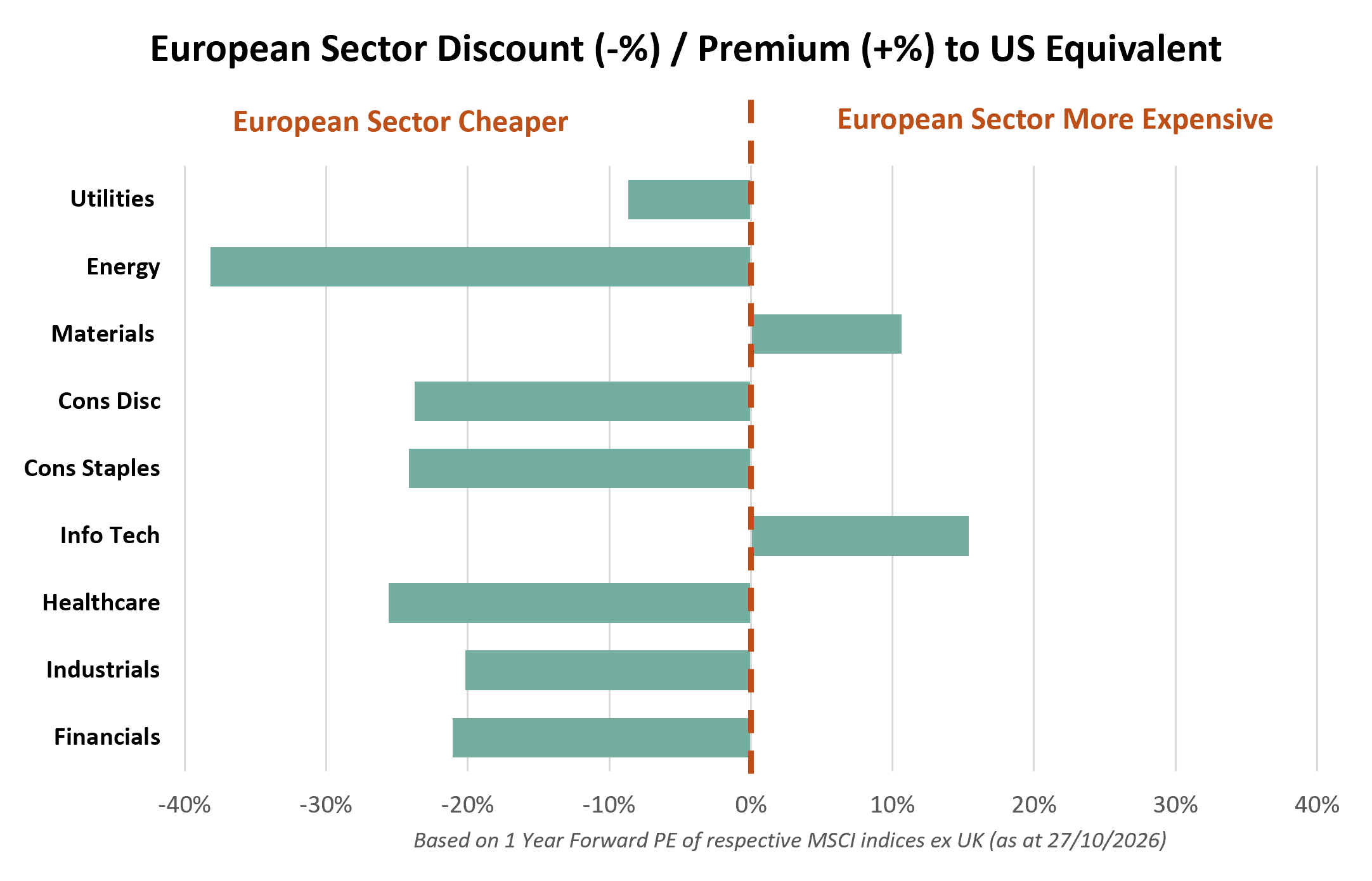
In his sequel, The Power of Geography, Marshall turns to the future, and to the choices nations make with the geographical cards they have been dealt. Europe is now making some of those choices, becoming more self-reliant in defence, energy and technology, and showing a greater willingness to use public spending to pay for it. Valuations suggest investors have yet to take much notice. Yet Europe is setting new terms on which its companies can thrive, and we believe markets will, in time, come to recognise that.
Sources:
1.US Bureau of Economic Analysis, September 2026.
2.Bloomberg, based on iShares MSCI ACWI ETF (ACWI US)
3.Bloomberg, forward (FY1) price-to-earnings ratios for MSCI Europe ex UK and MSCI USA, as at 27/10/2026.
4.Bloomberg, forward (FY1) price-to-earnings ratios for MSCI Europe ex UK and MSCI USA sector indices, as at 27/10/2026
5.MSCI Europe ex UK Index and MSCI USA Index factsheets, 30 September 2026
6.Turner & Townsend, Data Centre Construction Cost Index 2026, 26 October 2026.
Nothing in this article should be deemed to constitute the provision of financial, investment or other professional advice in any way. This article reflects McInroy & Wood’s opinions at the date of publication only, the opinions are subject to change without notice, and McInroy & Wood shall bear no liability for any loss arising from reliance on them.

 Jack McNair