This is a financial promotion issued by McInroy & Wood Limited, which is regulated by the Financial Conduct Authority. Please note that historic performance is not a guide to, or guarantee of, future returns. The value of investments and the income they generate can fluctuate and may go down as well as up.
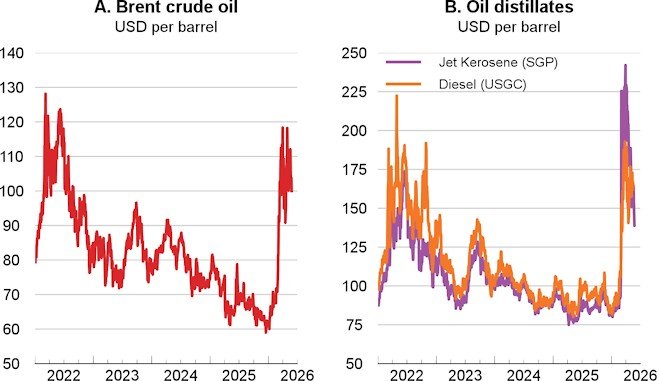
The global economy entered 2026 in a relatively strong position, but the Middle East conflict quickly reshaped the outlook. Disruption to oil and gas production and shipping routes triggered an energy shock, pushing up prices and exposing the fragility of global supply chains, as shown in charts A and B.
Source: OECD Economic Outlook June 2026
Yet while these near-term effects are significant, the more important theme is structural. The OECD recently highlighted that a clear priority for its members was to reduce their exposure to future shocks by diversifying sources of energy, strengthening electricity systems and using energy more efficiently.
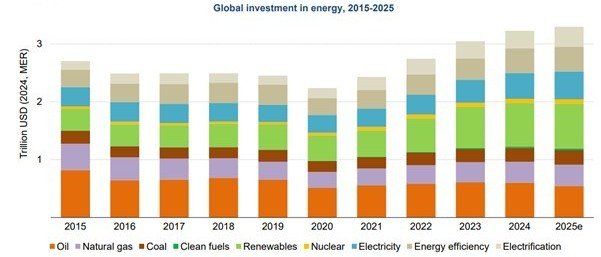
This shift is not without precedent. As discussed in our May 2025 insight featuring energy specialist Graham Cooley, the transition can be viewed as part of a broader “fourth industrial revolution”, defined by a move away from fossil fuels towards systems built around renewable energy and electrification (see chart C below). However, recent events have again brought the global economy’s vulnerability to oil prices back into focus.
Chart C
Source: IIGCC
As economies use more renewable energy, and face growing demand from electric transport, heating and data centres, the importance of reliable power networks is increasing. In western countries, households use energy predominantly to heat water and their homes, together accounting for about 70% of consumption. An ageing grid infrastructure is becoming a potential bottleneck, underscoring the need for substantial investment to keep energy flowing to families and businesses.
Demand for greater energy security and diversification of supplies is driving a sustained shift to renewable sources. Renewable energy offers two key advantages in the current context: it is generally domestically sourced and has low marginal production costs once installed. As governments seek to reduce dependence on imported fuels while stabilising long-term energy prices, these attributes appear increasingly valuable.
We believe this transition towards greater electrification will persist for decades, and all our balanced and income-orientated portfolios include companies that are well placed to benefit from this theme.
NextEra Energy is a US-based leader in renewable energy generation, with large-scale wind and solar portfolios alongside its natural gas, nuclear and battery storage assets. The infrastructure development division has a long project pipeline, with its scale and expertise making it a key partner for many data centre operators, an area where there is significant capital investment.
The implications extend beyond electricity generation and infrastructure into energy consumption. In 2025, the International Energy Agency estimated that “if all air conditioners bought since 2019 had been the most efficient model available, the world could have saved an amount of electricity equal to that used by data centres over the same period”.
As North America’s largest distributor of air conditioning systems, Watsco is uniquely positioned to benefit from changing energy efficiency regulations. The development of a digital platform and years of investment in its logistics capabilities will enable Watsco’s network of contractors to replace millions of outdated units over the next decade.
In an environment of elevated energy prices, lowering consumption provides an immediate and cost-effective response for businesses and governments. Traditionally known for its electrical components, Schneider Electric’s products are likely to be used by many readers every time they charge an electric vehicle. However, the company is also a leader in energy management and automation, developing software and digital tools to help data centres and other customers optimise their electricity usage. Digital systems that monitor and improve energy use, alongside more efficient equipment, offer a way to reduce exposure to external shocks while supporting longer-term decarbonisation goals.
Even if shipping through the Strait of Hormuz returns to normal, the crisis is likely to accelerate a transition that is already underway. For governments, investment in grid infrastructure is becoming unavoidable as demand rises and power systems age. Whilst returns are never guaranteed, we believe businesses such as NextEra Energy, Watsco and Schneider Electric are integral to building more resilient energy systems, that reduce reliance on imported fuels and enhance security of supply. While oil and gas will continue to play a role, the long-term trajectory towards electrification and renewables now looks increasingly irreversible.
Sources:
OECD Economic Outlook June 2026 No 119 ; IEA Energy Efficiency 2025 Report; IIGCC Insight World Energy Investment 2025
Nothing in this article should be deemed to constitute the provision of financial, investment or other professional advice in any way. This article reflects McInroy & Wood’s opinions at the date of publication only, the opinions are subject to change without notice, and McInroy & Wood shall bear no liability for any loss arising from reliance on them.

 Guido Bicocchi